Dowel drill – Through drill (with flat)
When a dowel hole must go all the way through the workpiece, choose a through drill with flat. These dowel drills are ground to leave a clean hole edge at exit. The flat on the shank secures the drill firmly in the holder.
The range includes pointed dowel drills and standard versions, each in left-hand and right-hand rotation for the alternating spindles of multi-spindle drill heads. The pointed tip minimizes tear-out on the underside of the workpiece.
What diameter should the borehole be?
Filters
Availability
D (diameter) in mm
Connection type
Cutting material
I (effective cutting length) in mm
L (total length) in mm
L1 (length 1) in mm
S (shank) in mm
Z (number of teeth / cutting edges)
Line
Rotation direction
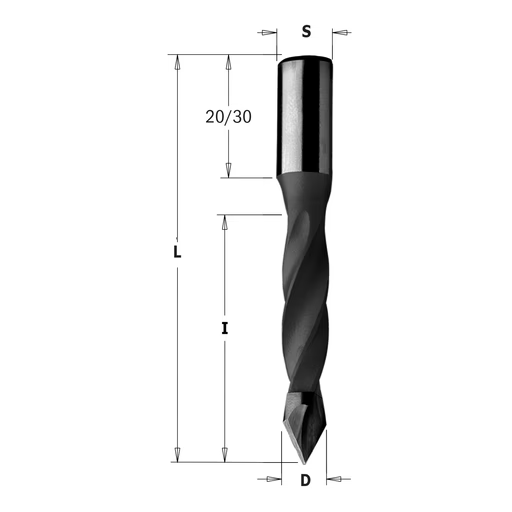
Pointed centre drill, right-hand D=7mm L=70mm L1=20mm I=40mm
- I=40mm LT=70mm
- S=10x20mm Z2
- RH (right-hand) HW
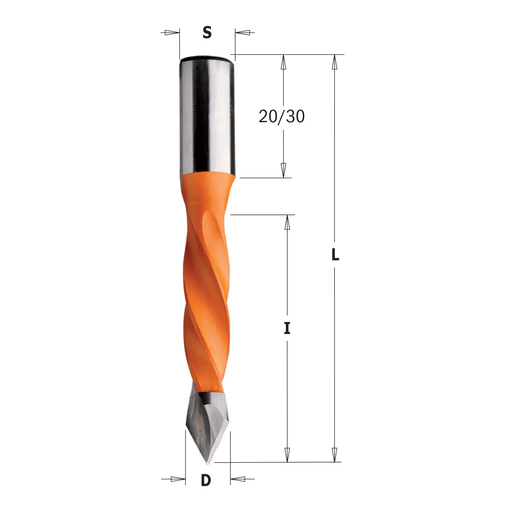
Pointed dowel drill, left D=7mm L=70mm L1=20mm I=40mm
- I=40mm LT=70mm
- S=10x20mm Z2
- LH (left-hand) HW
Pointed centre drill, right-hand D=8mm L=70mm L1=20mm I=40mm
- I=40mm LT=70mm
- S=10x20mm Z2
- RH (right-hand rotation) HW
Pointed dowel drill, left D=8mm L=70mm L1=20mm I=40mm
- I=40mm LT=70mm
- S=10x20mm Z2
- LH (left-hand rotation) HW
Pointed centre drill, right-hand D=9mm L=70mm L1=20mm I=40mm
- I=40mm LT=70mm
- S=10x20mm Z2
- RH (right-hand rotation) HW
Pointed dowel drill, left D=9mm L=70mm L1=20mm I=40mm
- I=40mm LT=70mm
- S=10x20mm Z2
- LH (left-hand rotation) HW
Pointed centre drill, right-hand D=10mm L=70mm L1=20mm I=40mm
- I=40mm LT=70mm
- S=10x20mm Z2
- RH (right-hand rotating) HW
Pointed dowel drill, left D=10mm L=70mm L1=20mm I=40mm
- I=40mm LT=70mm
- S=10x20mm Z2
- LH (left-hand rotation) HW
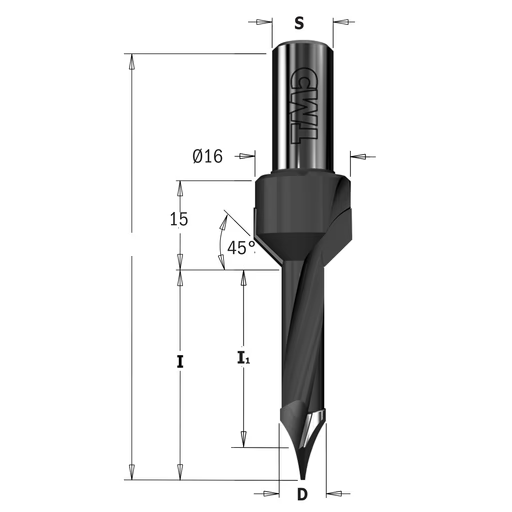
Dowel drill with fixed countersink, right-hand D=5mm L=70mm I=35mm
- I=35mm LT=70mm
- S=10x15mm Z2
- RH (right-hand) HW
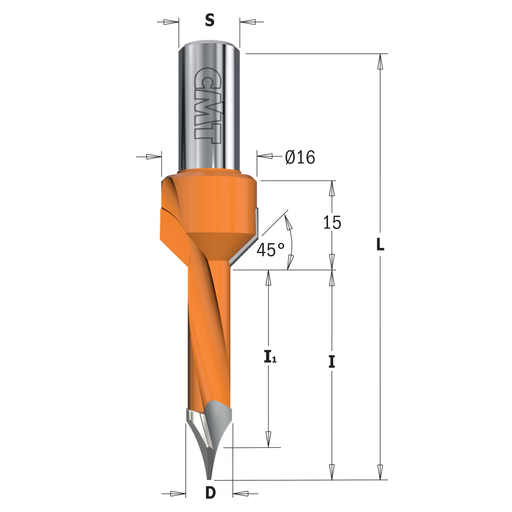
Dowel drill with fixed countersink, left-hand D=5mm L=70mm I=35mm
- I=35mm LT=70mm
- S=10x15mm Z2
- LH (left-hand) HW
Dowel drill with fixed countersink, right-hand D=7mm L=70mm I=35mm
- I=35mm LT=70mm
- S=10x15mm Z2
- RH (clockwise) HW
Dowel drill with fixed countersink, left-hand D=7mm L=70mm I=35mm
- I=35mm LT=70mm
- S=10x15mm Z2
- LH (left-hand rotation) HW
Dowel drill with fixed countersink, right-hand D=8mm L=70mm I=35mm
- I=35mm LT=70mm
- S=10x15mm Z2
- RH (right-hand) HW
Dowel drill with fixed countersink, left-hand D=8mm L=70mm I=35mm
- I=35mm LT=70mm
- S=10x15mm Z2
- LH (left-hand) HW
Dowel drill with fixed countersink, right-hand D=10mm L=70mm I=35mm
- I=35mm LT=70mm
- S=10x15mm Z2
- RH (right-hand rotation) HW
Dowel drill with fixed countersink, left-hand D=10mm L=70mm I=35mm
- I=35mm LT=70mm
- S=10x15mm Z2
- LH (left-hand) HW
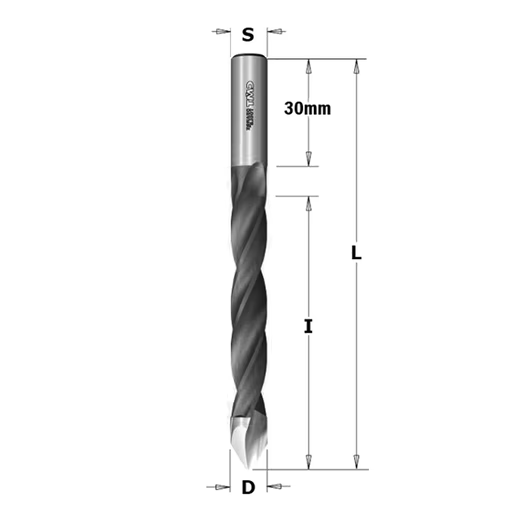
Pointed centre drill, right-hand D=5mm L=115mm L1=30mm I=70mm
- I=70mm LT=115mm
- S=10x30mm Z2
- RH (right-hand rotating) HW
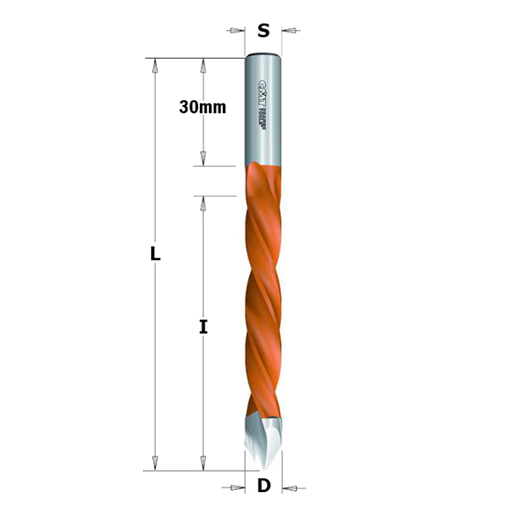
Pointed dowel drill, left D=5mm L=115mm L1=30mm I=70mm
- I=70mm LT=115mm
- S=10x30mm Z2
- LH (left-hand rotation) HW
Pointed centre drill, right-hand D=6mm L=115mm L1=30mm I=70mm
- I=70mm LT=115mm
- S=10x30mm Z2
- RH (right-hand rotation) HW
Pointed dowel drill, left D=6mm L=115mm L1=30mm I=70mm
- I=70mm LT=115mm
- S=10x30mm Z2
- LH (left-hand rotation) HW
Pointed centre drill, right-hand D=8mm L=115mm L1=30mm I=70mm
- I=70mm LT=115mm
- S=10x30mm Z2
- RH (right-hand rotation) HW
Pointed dowel drill, left D=8mm L=115mm L1=30mm I=70mm
- I=70mm LT=115mm
- S=10x30mm Z2
- LH (left-hand) HW
Pointed centre drill, right-hand D=10mm L=115mm L1=30mm I=70mm
- I=70mm LT=115mm
- S=10x30mm Z2
- RH (right-hand rotation) HW
Pointed dowel drill, left D=10mm L=115mm L1=30mm I=70mm
- I=70mm LT=115mm
- S=10x30mm Z2
- LH (left-hand) HW
24 of 154 products shown
Through drilling bits with a clamping flat for through holes
A through drilling bit is a dowel bit for holes that go completely through the workpiece or panel, such as assembly and through holes on drilling machines and CNC drilling heads. Instead of a flat bottom with pre-cutters, it has a pointed tip that cuts the material evenly on the exit side. The shank with clamping flat, usually 10 mm, is clamped in the drill chuck with a setscrew, so the drill cannot slip or sink down.
Through drilling or blind drilling
For a blind dowel hole, the flat bottom is decisive: for that you use the standard dowel bit with clamping flat. For a through hole, the edge on the back side matters most, and there the pointed tip works better: it centers when starting and cuts the material gradually as it exits instead of pushing it away. That makes the through drilling bit the right choice for pass-throughs in rear panels, assembly holes for connector hardware and holes that remain visible on both sides.
Versions and sizes
The range includes diameters from 2 to 14 mm, including inch sizes such as 6.35 and 9.52 mm, in left-hand and right-hand versions for the alternately rotating spindles of a drilling unit. In addition to through drilling bits with brazed carbide, there are solid carbide spiral drills with a 120° point, dowel bits with fixed countersink and PCD diamond versions for abrasive sheet materials. Reduce the feed when breaking through and support the panel so that the underside also remains clean.
What is the difference between a through drilling bit and a standard dowel bit?
Can I also drill blind holes with a through drilling bit?
Which rotation direction do I need?
When should I choose a PCD diamond drill?
Related categories
- Dowel drill bit – Standard (with clamping flat)
- Hole saws
- Diamond drills
- Speed drills
- Dowel drill bit – System (Festool)
- Dowel drill bit – System (Mafell)
- Slot drills
- Forstner Bits
- Rosette Cutters
- Dowel drill – threaded shank
- Countersinks
- Plug cutters
- Cylindrical head drills
- Industrial lock mortising cutters
- Fish-mouth drills
- Spiral drills
- Square mortise bits